How to File a Petition When Your Birth Certificate is Blurred
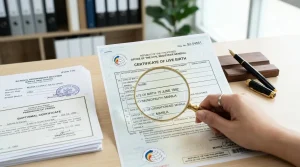
Finding out your birth certificate is blurred, right when you need it most, is genuinely stressful. But here is the thing: this is a known problem with a known solution. The Philippine Statistics Authority recognizes that document age, ink fades, and registry copies deteriorate. As a result, there is a proper administrative process called a Petition for Reconstruction that legally restores the record. No court. No lawyer. Just the right steps, done correctly.
This guide walks you through the whole thing clearly so you know exactly what to do, in what order, and why each step matters.
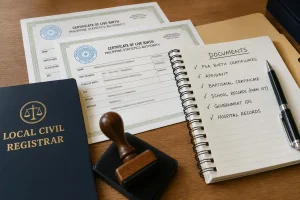
Documents That Build a Strong Petition:
The supporting documents do the heavy lifting here. Their job is to prove through independent evidence what the original birth certificate stated. Specifically: the full name, date of birth, place of birth, and parents’ names.
1) A Baptismal certificate tends to be the strongest piece of evidence. Churches issued these within days or weeks of a birth, using the same information that went into the civil registry. The alignment between the two records is usually very close, which makes this document highly credible to the civil registrar.
2) School records, Form 137, diplomas, and early enrollment documents were all prepared based on the original birth certificate. They serve as independent institutional confirmation of the same information.
3) Hospital records fill in clinical details that other documents sometimes cannot. The mother’s obstetrical records, delivery logs, and newborn screening results confirm the birth date, birth location, and parental identities with specificity.
4) Government IDs and other civil registry documents, such as a passport, voter’s ID, or marriage certificate, strengthen the submission by showing that entries on the original document were consistent with what was recorded in these later transactions.
5) An affidavit from a parent, sibling, or family member with direct knowledge of the birth adds personal testimony alongside the institutional evidence.
Every document submitted must be a certified true copy authenticated by the issuing institution. The more documents there are, and the more consistent they are with each other, the stronger the petition.
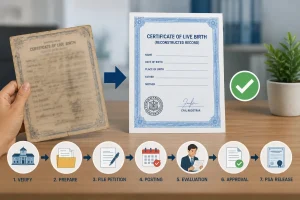
The Filing Process, Step by Step:
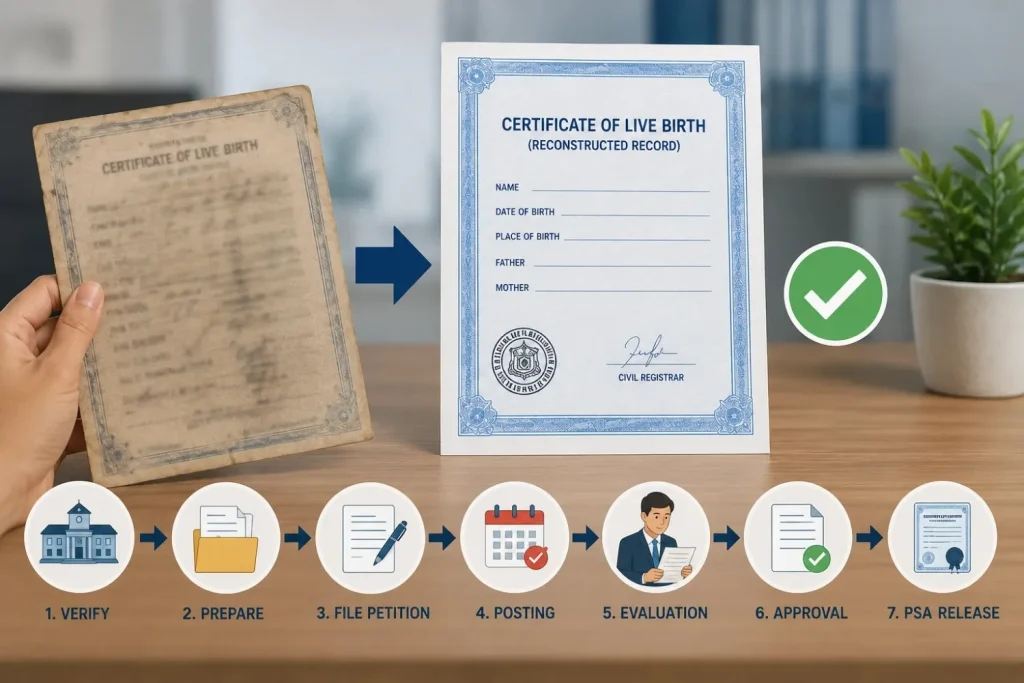
Step 1: Verify both copies. Visit the LCR of the birthplace, present the blurred PSA copy, and request a formal verification of the LCR record. Secure written confirmation that the LCR copy is also unreadable. This document is the starting point of the petition.
Step 2: Prepare supporting documents. Collect certified true copies of all supporting documents. Bring both certified copies and originals to the LCR on filing day.
Step 3: Complete the petition form. Fill out every section of the petition form. The LCR provides the petitioner’s details, the reconstructed facts, and a complete list of attached documents. Nothing should be left blank.
Step 4: Pay the filing fee. Fees vary by location but generally fall between a few hundred pesos and roughly one thousand pesos for reconstruction petitions. Always secure an official receipt.
Step 5: Posting period. The LCR posts a public notice of the petition for ten consecutive days. This is a legal requirement giving any interested party the right to contest the facts being reconstructed.
Step 6: Civil registrar evaluation. After posting, the civil registrar reviews all submitted documents, may request additional evidence, and issues a decision. This stage takes several weeks. A complete and consistent submission shortens this considerably.
Step 7: Registration and PSA transmission. Upon approval, the LCR registers the reconstructed entry and forwards it to the PSA. Once the PSA activates the record, the new certified copy becomes available for request.
Five Reasons Birth Certificates Become Unreadable
Before anything else, it helps to know what actually caused the blurring because the cause determines the fix.
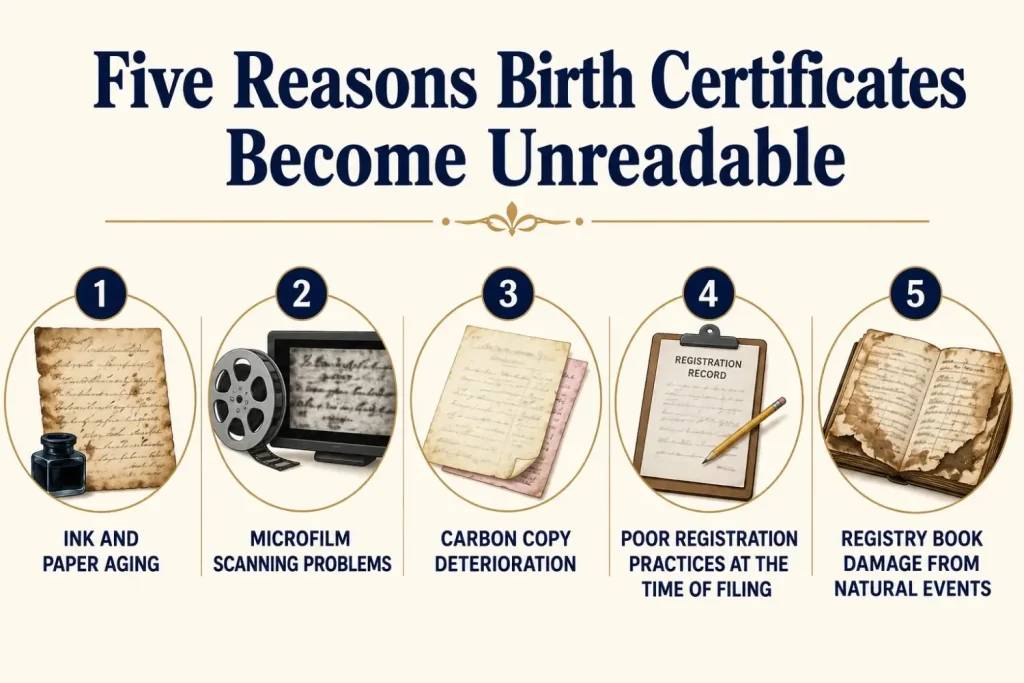
- Ink and paper aging. Certificates registered before the 1980s were handwritten on ordinary paper with ink that was never designed to survive decades of humidity and heat. The writing fades slowly, and most people do not notice until the document is pulled out for a transaction and the entries are already gone.
- Microfilm scanning problems. When civil registry offices began digitizing old registry books, they used microfilm cameras. A worn registry book, a dusty lens, or a poorly maintained machine produced blurred scans, and those blurred images became the official PSA copy stored in the database. The physical certificate at home may look fine, but the PSA copy has been blurred because it was scanned.
- Carbon copy deterioration. Original birth certificates were filed in sets. The copy that went into the official registry was often a carbon copy, not an original ink. Carbon impressions are naturally lighter, and over fifty or sixty years, they can become nearly unreadable even under good conditions.
- Poor Registration Practices at the Time of Filing
This cause is less talked about but fairly common in rural areas and smaller municipalities, particularly in records from the 1950s through the 1970s. Civil registration was not always carried out under strict supervision during that period. Some entries were recorded by local officials using whatever writing materials were available: pencil, low-quality ballpoint ink, or even diluted ink, none of which were built for permanence. The result is that the original entry was already faint when it was written, long before any additional environmental damage occurred. - Registry Book Damage from Natural Events. Floods, fires, and typhoons have affected civil registry offices across the Philippines at various points in history. When a registry book is partially damaged by water or fire, the affected pages often survive in degraded form rather than being destroyed entirely. The entries on those pages become blurred, stained, or partially obscured, and because the book itself is still considered an existing record, it stays in the system rather than being flagged for reconstruction. Many people discover this is the source of their blurred certificate only after they visit the LCR and see the condition of the original registry book firsthand.
Before Filing Any Petition, Do This First
This step saves a lot of unnecessary effort, and many people skip it entirely.
Request certified copies from two separate offices at the same time: the PSA and the Local Civil Registrar (LCR) of the city or municipality where the birth was registered. These two offices hold independent copies of the same record. One copy being blurred does not automatically mean the other is.
It happens more often than people expect. The PSA copy is blurred while the LCR registry book still has a perfectly readable entry. When that is the case, no petition is needed. The LCR certifies a copy of the readable entry, and the matter is resolved without going through reconstruction.
Reconstruction is necessary when both copies of the PSA and the LCR are confirmed unreadable. Once that is established, ask the LCR to put that confirmation in writing. That written confirmation becomes the foundation of the petition.
Which Law Actually Covers This Situation
Two laws recur in civil registry matters, and it is worth being clear about what each one does.
Republic Act 9048 allows the Local Civil Registrar to correct clerical and typographical errors and to approve first name changes without a court order. Republic Act 10172 extended this to include corrections to the day and month of birth and to sex entries.
Both laws address entries that are readable but wrong. A misspelled name, or an incorrect birth month falls under RA 9048 and RA 10172.
A blurred certificate is a different problem entirely. There is no specific incorrect entry to fix. For dual records or family name issues, see how to fix PSA duplicate and surname errors. The content itself is unverifiable because it cannot be read. That gap is what pushes the situation into Petition for Reconstruction territory, which operates under a separate set of PSA administrative guidelines.
One nuance worth noting: if the blurring is partial and some entries are still legible, reconstruction and correction procedures can work together. Reconstruction restores the full record first, then RA 9048 handles any specific errors that still need fixing afterward.
What the Petition for Reconstruction Actually Does
Simply put, the Petition for Reconstruction is a formal request to the Local Civil Registrar to legally recreate the civil registry entry using evidence from secondary documents. Once approved, the recreated entry is officially registered, transmitted to the PSA, and a new certified copy becomes requestable through normal channels.
Two things are non-negotiable about this process. First, the petition must be filed at the LCR of the place of birth, not the LCR where the person currently lives. This is a point that causes unnecessary confusion. Jurisdiction over the original entry belongs to the office in the birthplace, period. Second, personal appearance at the LCR is required at certain stages. This cannot be handled entirely online.
The PSA activation after approval takes several months, so patience is part of the process from the beginning.
Why Some Petitions Stall or Get Rejected
These are the four most common problems, and all of them are avoidable.
Submit plain photocopies. Every document needs to be a certified true copy from the issuing institution. Photocopies, even clear ones, are not accepted and will result in the submission being returned.
Name spelling inconsistencies across documents. If the baptismal certificate and the school record spell the name differently, the civil registrar will pause the evaluation and ask for affidavits explaining the discrepancy. Catching this before filing, not after, saves weeks.
Filing at the wrong LCR. The petition goes to the LCR of the birthplace. Filing anywhere else means starting the location process over. This is one of the more frustrating avoidable mistakes.
Incomplete petition forms. Blank fields, missing signatures, or skipped sections create back-and-forth that delays the timeline.
What Happens After Reconstruction is Approved
Once the reconstructed record is active in the PSA system, requesting a certified copy works the same way as any regular PSA birth certificate request online or in person, with the same fees and turnaround times.
The new certificate carries an annotation showing it is a reconstructed record. This is standard and expected. Government agencies, schools, employers, and private institutions throughout the Philippines recognize and accept annotated reconstructed certificates without issue.
It is worth requesting at least three certified copies once the record becomes available. Having extras on hand avoids the need to request a new copy or repeat requests every time a new copy is needed for a different transaction.
Conclusion:
A blurred birth certificate has a clear, workable solution. The Petition for Reconstruction was created for exactly this situation because documents age, storage conditions are imperfect, and access to one’s own civil identity should not be permanently blocked by the deterioration of a piece of paper. Start by confirming both copies are unreadable, gather a solid set of consistent supporting documents, file at the correct LCR, and work through each step carefully. The result is a legally sound, fully valid civil registry record that serves every purpose the original was meant to serve.