🔐 2026 Security Upgrade Guide
PSA vs NSO Birth Certificate: Understanding the Security Upgrade
For a long time, Filipinos knew their birth records solely by the name “NSO.” As we navigate through 2026, the landscape has changed significantly. Beyond a logo change, the evolution from NSO to PSA represents a massive leap in how our most personal data is protected and verified, powered by the CRS-ITP2 high-tech verification ecosystem.
The Key Difference: More Than Just a Name Change
When people mention a PSA NSO birth certificate, most assume the only real difference is the name on the letterhead. On the surface, both documents tell the same basic story: when and where you were born, who your parents are. But underneath, the way they’re made, stored, and secured might as well come from different centuries.
The 2016 Merger and Beyond
The Philippine Statistics Authority (PSA) was created by bringing together four government agencies, with the old National Statistics Office (NSO) at its core. This was done to centralize all government data under one roof. Today, the PSA doesn’t just print papers; it manages the entire lifecycle of a citizen’s registration. This central authority ensures that whether you are in Manila or abroad, your record is accessible and consistent.
The CRS-ITP2 Advantage
The CRS-ITP2 is the backbone of the 2026 system. It makes the PSA database significantly more reliable than the old NSO archives. It fixes the “broken links” between local town halls and the national database, ensuring that when you request a copy, the information is accurate and up to date with the latest legal updates.
🔬 NSO vs PSA: A Technical Evolution
If you hold a legacy NSO document next to a 2026 PSA copy, the technical differences are striking: the modern security paper features more intricate background patterns and color-shifting elements designed to prevent digital scanning fraud.
📄 Security Paper (SECPA)
The 2026 PSA paper features thermochromic ink (changes color when rubbed), micro-letters invisible to the naked eye, and a unique 2026 watermark nearly impossible to forge. The old NSO yellow paper is now outdated.
🔢 BReN vs. PRN
The old NSO used a Population Reference Number (PRN). In 2026, every PSA document uses a Birth Reference Number (BReN), the unique identifier that allows digital systems to pull up your record in seconds during a verification check.
⚡ Bottom Line
Same birth story. Completely different security technology underneath. This ensures your most personal information remains protected by the highest modern standards.
When to Use Each: Is Your NSO Copy Still Valid in 2026?
Major government agencies have officially closed the door on legacy NSO documents for almost all official transactions.
DFA & Passport Requirements
The Department of Foreign Affairs now strictly rejects NSO copies. If you are applying for a passport or a renewal, you must present a PSA copy printed on the latest security paper to ensure immediate acceptance.
2026 Bar Exam & PRC Mandate
Professional regulations now require all examinees to follow the PSA birth certificate requirements for identity verification, ensuring every professional’s identity is verified through the most secure channel available.
Embassy & Visa Standards
Most foreign embassies now look for “freshness.” They often require a PSA copy issued within the last 6 to 12 months to ensure no recent changes or annotations have been missed and to verify current authenticity.
⚖️
Republic Act No.11909 legally mandates the permanent validity of certificates issued by the PSA and NSO. Under this law, your record remains valid as long as the document is intact and readable. However, the shift to PSA security paper is required for official 2026 government transactions.
PSA vs. Birth Certificate: Clearing the Confusion
It is easy to get confused by the terminology used at government windows. Let’s clear up the difference between PSA and a birth certificate once and for all.
PSA vs. Birth Certificate
A “Birth Certificate” is the type of document the record of your birth. “PSA” is the authority that certifies it. Think of it like a brand name.
While a local civil registrar can give you a copy of your birth record, it is the PSA certification that makes it “official” for national and international use. This centralized verification ensures that your identity is recognized and accepted by all major government institutions.
💡 PSA Birth Certificate = The document type + The certifying authority together.
LAUNCHED FEBRUARY 2026
The E-Certificate Rollout
February 2026 saw the full rollout of the PSA E-Certificate, a cryptographically secured PDF that the NSO never had. It’s a digital version you can store on your phone.
Tips for Verification: How to Spot a 2026 Genuine PSA Copy
Understanding the differences between PSA and NSO birth certificates is key to avoiding fraud. In 2026, you don’t need to be an expert to verify a document.
QR Code Live-Sync
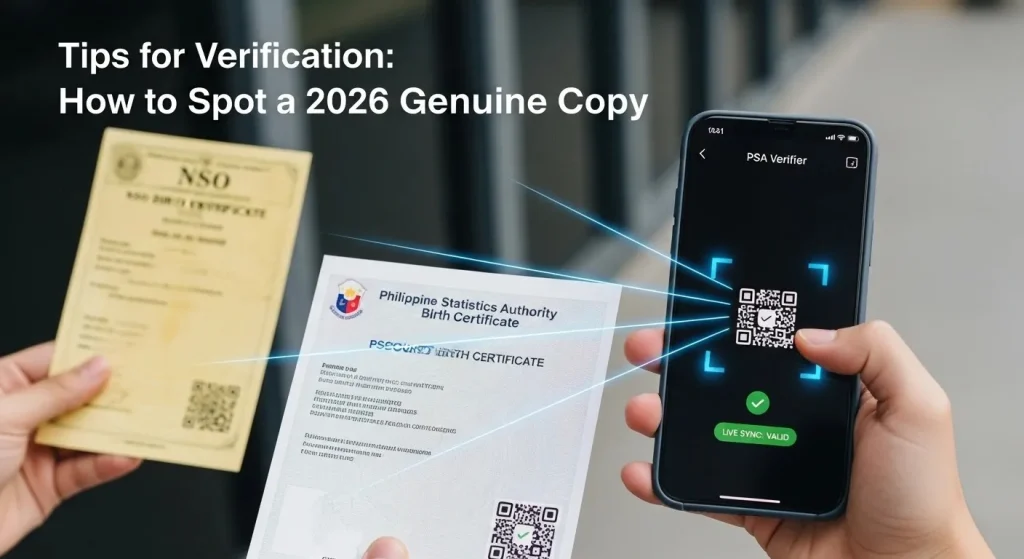
Every modern PSA document now features a QR code. By using the official PSA Verifier app, you can scan this code to see a “Live-Sync” of the record. This instant verification confirms that the physical paper matches the latest data stored in the national server.
How to verify:
⚠️ If info doesn’t match the document is either stale or fake.
The “Liveness” Check
Banks and government offices are moving toward a “Liveness Check.” Instead of just looking at the paper, they scan the digital hash embedded in the document. This ensures the record is active in the national database.
✅
2026 PSA Copy
Has a digital heartbeat active in the national database, verifiable instantly.
❌
Old NSO Record
Lacks this digital heartbeat, which is being phased out in favor of the PSA standard.
Solving the "Missing Record" Challenge
Finding out there is “No Record Found” can be stressful, but in 2026, this is a problem with a clear solution rather than a dead end.
The Database Sync Process Explained
Sometimes, your birth was registered at the Local Civil Registry (LCR), but it hasn’t “synced” with the national PSA database. This usually happens during the “Sync Gap.” You should wait for the system to refresh and check your status for 24 hours before checking again.
💡 It doesn’t mean you don’t exist; it just means the two systems haven’t yet talked to each other. Wait 24 hours before checking again.
Step-by-Step Endorsement Workflow
In 2026, you can use the Premium Annotation Service. If your record is missing, you can request an “Endorsement” from your LCR. Under the new guidelines, this process is prioritized you can often get your record uploaded and certified by the PSA in as little as 10 working days. This is a massive improvement over the months of waiting required in previous years.
🔍 Your 2026 Recovery Path
Check PSA Portal
Search for your record. If “No Record Found,” wait 24 hours and try again . This is the Sync Gap.
Visit Your LCR
Go to your Local Civil Registry and request a formal Endorsement to the PSA national database.
Premium Annotation Service
Use the 2026 prioritized service record uploaded and PSA-certified in as little as 10 working days.
✅ Once endorsed, order your annotated PSA copy online for delivery.
NSO vs PSA: Feature-by-Feature
| Feature | 📄 Old NSO | 🔐 PSA 2026 |
|---|---|---|
| Security Paper | Plain yellow SECPA | Thermochromic ink + micro-printing + 2026 watermark |
| Reference Number | PRN (Population Reference Number) | BReN (Birth Reference Number) |
| QR Code Verification | ❌ | ✅Live-Sync via PSA Verifier app |
| E-Certificate Option | ❌ | ✅Cryptographically secured PDF |
| Digital Heartbeat | ❌ | ✅Active in national database |
| DFA Passport Acceptance | ❌ Rejected in 2026 | ✅ Required |
Conclusion: Transitioning to the 2026 Standard
Holding onto an old NSO birth certificate might feel sentimental, but it is a practical risk in 2026. Whether you are applying for a job, a passport, or a school spot, having a modern PSA copy is the only way to ensure your transaction goes smoothly. The move toward the E-Certificate and high-security SECPA paper isn’t just about red tape; it’s about protecting your identity. By upgrading to a PSA copy today, you can learn how to get a PSA birth certificate in the safest and most efficient way to verify your identity.
By upgrading to a PSA copy today, you ensure your identity is verified through the safest and most efficient channel , ready for whatever 2026 demands.
Frequently Asked Questions
The 2026 PSA paper includes thermochromic ink, specific micro-printing, and a digital QR code for instant verification features that the old NSO yellow paper completely lacks.
Yes. As of 2026, most major Philippine banks accept the cryptographically secured E-Certificate as a valid form of identification when accompanied by a scan of the digital signature.
Annotations are used to show legal changes, such as name corrections or legitimization. In 2026, these are necessary to demonstrate that your record is the most current and legally valid version available.
No. The DFA now requires a PSA-certified birth certificate printed on the most recent security paper to ensure all security features are up to date. NSO copies are strictly rejected for passport applications.